
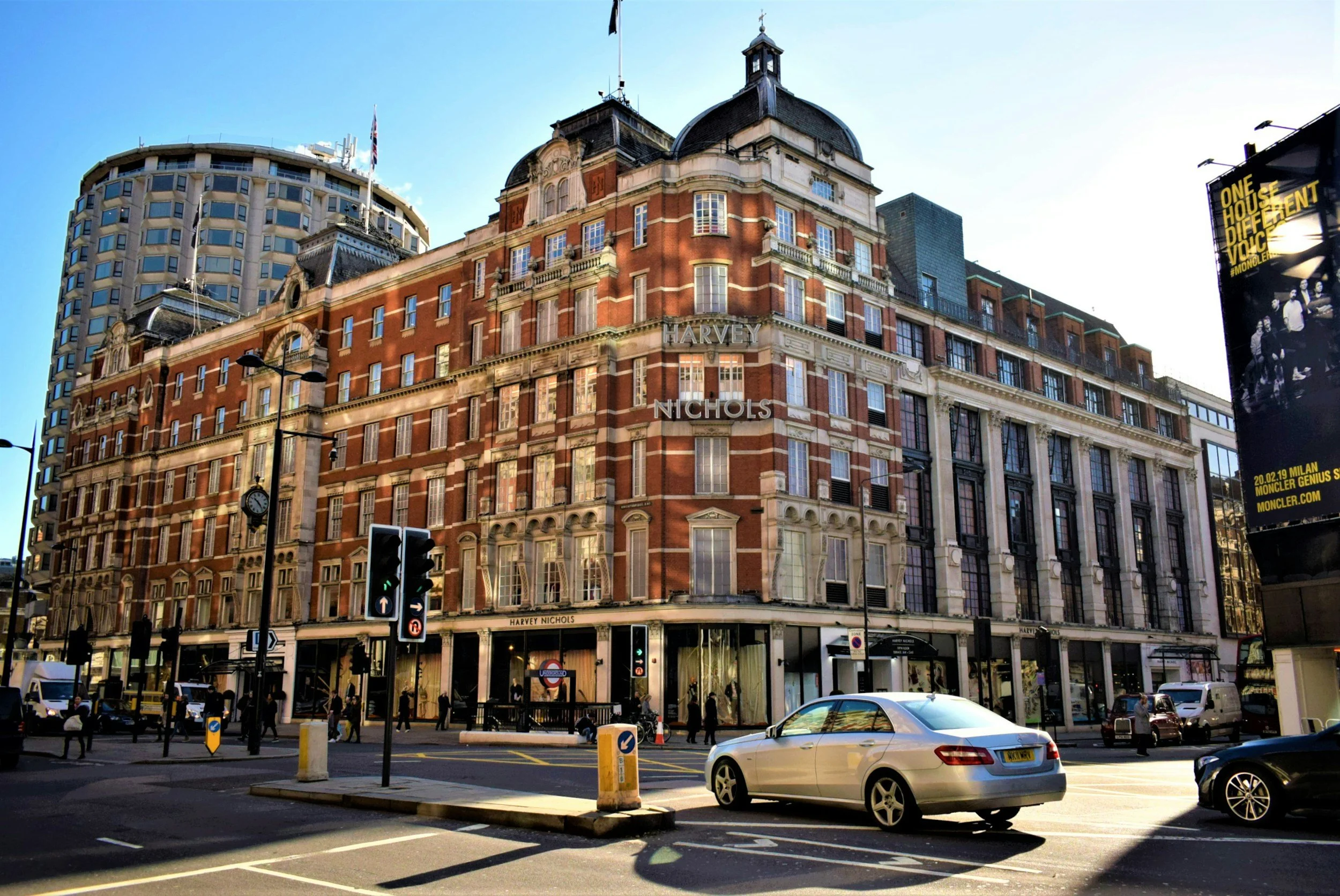
Harvey Nichols, Selfridges, and the Succession Question.
How two London department stores faced the same problem and arrived at very different places
How two London department stores faced the same problem and arrived at very different places.
Frasers Group completed the acquisition of Harvey Nichols on 13 August. Pre-pack administration. Six UK stores, the online business, more than 1,000 employees, and a portfolio of over 800 premium and luxury brands. The FT reported a price of roughly £40 million. Frasers hasn’t confirmed the figure.
Dickson Poon bought Harvey Nichols from Burton Group in 1991 for £51 million. Five years later, with Joseph Wan running the business, it floated on the London Stock Exchange at a valuation of £148.5 million. Shares priced at the top of the range. A P/E of 26. Poon retained 50.1%, took £64 million off the table, and still owned the majority of a business worth nearly three times what he’d paid.
Thirty-five years later, it’s gone for roughly £40 million. Less than Poon originally paid.
Revenue fell from £204.9 million to £184.8 million in the last financial year alone. The post-tax loss widened to £48.7 million from £34.1 million. The stores had become tired. The online business was never properly invested in. The brand lost its connection with a younger generation of luxury consumers who moved on. The Poon family kept funding the losses until eventually the funding stopped.
But the numbers are a symptom. The cause runs deeper. And I know this world well enough to see what happened.
I worked alongside Paul Kelly when we transformed the Switzer Group into the Brown Thomas Group after the Westons acquired the Irish arm of House of Fraser. Kelly was my mentor then. He’s still a friend. So when I look at Harvey Nichols now, I’m not reading it as a news story. I’m looking at what went wrong with the succession after Wan left, and comparing it to what went right at Selfridges under Kelly and the Westons.
Wan ran Harvey Nichols for 22 years. He arrived in 1992 when the store was tired and turned it into the most talked-about fashion retailer in Britain. The fifth floor food hall. The Absolutely Fabulous years. Leeds in 1996, Edinburgh and Manchester in 2002. He made Harvey Nichols mean something.
But Wan wasn’t just a showman. He was a chartered accountant by training. A financial pragmatist who wouldn’t expand unless the rent economics were right. He piloted the business through its acquisition from Burton Group at £51 million, built it into a £148.5 million business by the 1996 IPO, and navigated the privatisation when Poon took it back. He built the OXO Tower as a high-margin hospitality anchor. When Lehman Brothers collapsed in 2008 he was in New York. He called the buying office in London that day and told them to cancel orders and return stock. Didn’t wait for a board meeting. Just picked up the phone. That single call, he said afterwards, saved the company from disaster.
Over 22 years, the chartered accountant had become a merchant without ever losing the financial discipline. That combination is what held Harvey Nichols together.
When Wan retired in 2014, the board looked at his background and saw chartered accountant. So they hired another finance person. Stacey Cartwright from Burberry. But Wan hadn’t stayed a chartered accountant. He’d spent 22 years becoming a merchant on top of it. Cartwright arrived with the same starting point Wan had. She just hadn’t made the same journey.
Cartwright lasted four years. Then two co-COOs. Then one of them alone. Four leaders in a decade. None of them carried what Wan carried.
Harvey Nichols didn’t collapse because of one bad decision. It drifted. Slowly, over ten years, without anyone at the top who combined both sides of what Wan had been. The stores became tired because nobody fought to keep them fresh. The online business stalled because nobody with merchant instinct was driving it. The brand lost relevance because nobody was making the creative calls that Wan would have made instinctively.
The OXO Tower, the hospitality anchor Wan built as a high-margin destination, wasn’t even included in the Frasers deal. It was sold separately. The disaggregation of what Wan had assembled for Dickson Poon is now complete.
Selfridges faced the same question a decade earlier.
Vittorio Radice transformed Selfridges from 1996 to 2003. Central escalators, yellow bags, experiential retail before anyone used the term. Then he left for M&S.
The board promoted Peter Williams, Radice’s finance director, into the CEO role. Same pattern. A leader who combined creative vision with commercial discipline replaced by someone who carried the financial credentials but not the merchant instinct. Williams lasted less than a year.
Then the Westons took control and the story changes entirely.
The Westons had already built something in Ireland and in Canada, where they owned Holt Renfrew. They’d acquired the Irish arm of House of Fraser, the Switzer Group, and appointed Paul Kelly to run it. I was there. Kelly and I worked together to transform Switzer’s into the Brown Thomas Group. A business built from the ground up.
When the Westons acquired Selfridges, they didn’t run a search. They already had Kelly. They’d known him since 1984. Galen Weston had watched him run Brown Thomas for over a decade and knew exactly what he was getting.
Kelly was the same kind of operator Wan had become. Merchant eye, financial discipline, both working together. He didn’t try to be Radice. He built on what Radice created and ran it with the rigour the Westons required.
The Westons gave Kelly something Wan never had. Long-term private capital and the patience to let him invest without quarterly earnings pressure. Kelly used it. The Wonder Room, the designer shoe galleries, the Oxford Street flagship rebuilt as a theatrical shopping destination. These weren’t quick wins. They were long-term bets on what a department store could become, funded by owners who understood the sector well enough to wait for the return.
From that base, Kelly built the Selfridges Retail Group. He transformed Brown Thomas and Holt Renfrew, the businesses the Westons already owned. Then he led the acquisitions: Selfridges, then De Bijenkorf in the Netherlands, then Arnotts in Dublin. A global luxury department store group across four countries. He maintained Selfridges’ position as one of the leading retailers in the world.
That group sold in 2022 for £4 billion.
Two London department stores. Two visionary leaders who defined a generation. Both replaced by people who carried one half of what the predecessor had been. One business had an owner who already knew the right person. The other didn't.
The creative vision and the commercial discipline aren’t two different skills. They’re one skill. The operators who carry both are rare. Some of them start in finance and build the merchant eye over time. Wan proved that. Some start on the shop floor and learn the numbers. The starting point matters less than whether they end up carrying both.
When you find someone who does, you back them. When you lose someone who did, you don’t replace them with half the package.
The UK House of Fraser took a different path entirely. It ended up with Mike Ashley and became Frasers Group. Similar roots to the Weston businesses. Very different trajectory.
But I wouldn’t write Ashley off here.
Frasers calls it the Elevation Strategy. The push from Sports Direct into premium and luxury. Flannels is already established. The Webster and MILE sit alongside it. Relationships with Gucci, Prada, Moncler, Burberry, Dior. Harvey Nichols now gives the strategy a Knightsbridge flagship and a 195-year-old name.
And then there’s the Hugo Boss bid at €1.98 billion. If that completes, Ashley has a global luxury brand and the best department store site in London under the same roof.
The track record demands caution. MatchesFashion collapsed within months of Frasers acquiring it in 2023. The brand and IP were ultimately picked up for £19 million after 250 employees lost their jobs and £80 million of stock was left behind. House of Fraser has been through substantial restructuring since Frasers bought it out of administration. Neither is a reassuring precedent.
Michael Murray, Frasers’ CEO, said the turnaround will require tough choices and that Harvey Nichols could become a smaller business in the near term. That’s the right language. Whether the execution matches it is the test.
Harvey Nichols Knightsbridge is not MatchesFashion. It has walls. It has a location that generates footfall regardless of the brand inside it. It has a food hall and a restaurant culture that Wan built and that still draws customers even when the fashion floors don’t.
Nobody has compared Mike Ashley to Bernard Arnault before, I’m not sure anyone will again but bear with me. Arnault built LVMH by acquiring luxury brands at the right moment and running them as a portfolio under tight financial control. Ashley is doing a version of the same thing from a very different starting point. The Knightsbridge store as the anchor. Hugo Boss as the brand. Flannels and The Webster as the supporting formats. It might be time to start paying attention to where this is heading.
The Institutional Bench
Why who you hire matters less than what you hire them into
Why who you hire matters less than what you hire them into
1. The year of the internal CEO
Something happened in retail succession in 2026 that has not happened before. Five of the largest consumer businesses in the world appointed internal candidates to the CEO role within six months of each other.
Doug McMillon handed Walmart to John Furner in February. Furner joined Walmart in 1993 as an hourly associate in a Fayetteville, Arkansas store. He spent thirty-one years inside the company before taking the top job.
Best Buy named Jason Bonfig in May. Bonfig started as an inventory analyst in 1999. Twenty-seven years later, the board chose him over an external field that included sitting CEOs from other retailers.
Currys appointed Fredrik Tønnesen in June. Tønnesen joined the Norwegian contact centre twenty years ago. He ran Norway, then the Nordics as COO, then as CEO from March 2023. He recovered a business that had been through a severe post-Ukraine contraction. The board considered internal and external candidates and chose the operator who had already proved he could do the job. He takes the group on 3rd August.
Apple confirmed John Ternus for September. Twenty-five years inside the company. Hardware engineering through every major product cycle from the first MacBook Pro to Apple Vision Pro.
Lululemon appointed Heidi O’Neill, also for September. O’Neill spent twenty-seven years at Nike before leaving in 2025. Her appointment is more complicated than the others and worth examining separately.
Any one of these would be worth noting. Five in six months is a pattern.
The boards at Walmart, Best Buy, Currys, and Apple all reached the same conclusion independently. The right CEO was already inside the building. The external search confirmed rather than challenged the internal candidate.
That isn’t how most CEO successions work. Most boards default to an external hire when they want change and an internal hire when they want continuity. The 2026 appointments break that assumption. Furner, Bonfig, and Tønnesen were all appointed into businesses that needed to change direction. The boards chose internal candidates not for continuity but because the internal candidate had already proved they could do what the business needed next.
An internal appointment can be a vote of confidence in the operating model or a vote of confidence in a specific operator. When it’s the first, it risks ratifying what already exists. When it’s the second, it can be the most powerful succession decision a board makes.
2026 is the year that distinction became visible.
2. What the bench produced
The Currys bench is the clearest example of what an institution produces when the operating model is sound.
Four people who ran Currys have gone on to lead major UK consumer businesses this decade. Sebastian James left for Boots in 2018. Katie Bickerstaffe became Co-CEO of M&S, then joined the Sainsbury’s board. Alex Baldock is going to Boots this autumn. Fredrik Tønnesen takes the group on 3 August.
That isn’t a list of promotions. It’s a pattern. Currys didn’t just fill its own CEO role. It produced CEOs for three other companies across two sectors. Two of them went to the same company eight years apart. Boots has now hired consecutive Currys Group CEOs. That’s a statement about what Currys built and what Boots couldn’t build for itself.
The bench at Currys wasn’t an accident. It was built across three leadership eras. Bickerstaffe ran Dixons Carphone UK&I from 2008, building the culture that the next generation came through. James ran the group, then left for Boots. Baldock succeeded him and ran the business through Covid, the supply chain crisis, and a consumer electronics market that contracted sharply from 2022. Tønnesen came through the Nordics, recovering a business that had been through a severe post-Ukraine contraction. Operating profit more than tripled under his leadership. Colleague and customer satisfaction reached record levels.
Each of them was tested against a market that punished anyone who chased volume with price. The operating model forced discipline. The people who came through it were tested every quarter.
Best Buy built the same thing on a different timeline. Hubert Joly arrived in 2012, when the analysts had written the business off and the founder was trying to take it private at $24 a share. Joly didn’t start with a grand strategy. He walked the stores. He looked for what was already working. Renew Blue, announced in November 2012, had five priorities: customer experience, employees, vendors, cost, return on investment. By 2017 the stock had moved from $17 to over $50.
Joly retired the plan early and launched Best Buy 2020: Building the New Blue. He accelerated into the growth phase because the foundation was ready. Then he handed the business to Corie Barry, who kept building. Barry handed it to Jason Bonfig, who had been at the company since 1999.
Best Buy is a $41.7 billion business with a third of the North American specialty electronics market. The board could go internal because Joly built the bench and Barry kept building it. Three CEOs in sequence, each inheriting a stronger operating model than the one before.
Walmart is the longest-running version. Sam Walton founded the company in 1962. John Furner joined in 1993 as an hourly associate in a Fayetteville, Arkansas store. Between those two dates, Walmart built a succession culture so deep that the board could reach thirty-one years into the organisation and find someone who had worked every level of the business.
Furner ran Sam’s Club before taking the US CEO role. He knows the stores, the distribution centres, the supplier relationships, and the technology platform. He didn’t learn Walmart from a strategy deck. He learned it from the shop floor upward over three decades.
The bench wasn’t a development programme or a succession plan written in a document. It was what happened when the business worked properly. Good operators stayed because the model tested them. The bench grew because the model kept producing people worth promoting.
3. When the bench fails
On 20 August 2025, Target named Michael Fiddelke as its next CEO. The stock dropped nearly 10% on the day. A Mizuho Securities survey of 51 investors conducted before the announcement found that 96% favoured an external hire. The board went inside anyway.
Fiddelke is 49. He joined Target in 2003 as an intern. He was CFO from 2019 to 2024 and COO from early 2024. He took over as CEO on 1 February 2026. Christine Leahy, lead independent director, said the board had conducted “an extensive external search and assessment of many strong candidates” over several years. The board saw the same field the market saw. It chose differently.
The scepticism wasn’t about Fiddelke personally. It was about what he represented. He was the product of choices Brian Cornell had made over a decade. He was CFO through the 2022 inventory crisis. He was COO when footfall turned negative in ten of twelve months of 2025. He led the $2 billion efficiency programme. He knew where every cost sat.
The concern was whether the person who helped build the post-2022 operating model could be the person who dismantled it.
Cornell didn’t leave. He moved to executive chair on 1 February 2026. The man whose decade Fiddelke would need to unpick was still sitting in the chair seat.
Dave Lewis at Tesco is the case that boards study when the internal model has stopped working. Lewis arrived from Unilever in 2014. He owed the old model nothing. He sold Homeplus. He exited Fresh & Easy. He sold Dobbies, Giraffe, and Harris+Hoole. He cut £1.5 billion of cost and restored supplier relationships. By 2017 Tesco had returned to profitable growth. Lewis could do that because he had no decade of Tesco choices to defend.
The Target board made a different bet. It chose the insider who knew the business best, in the belief that deep knowledge of the problem was more valuable than distance from it.
Five months in, Fiddelke’s Q1 2026 results suggest the bet may be working. Sales increased 6.7% to $23.4 billion, well ahead of the 3.4% analysts had expected. Comparable sales rose 5.6%, the first positive comp in five quarters. All six core merchandising categories grew.
Fiddelke launched a $6 billion turnaround plan. Price cuts across 3,000 items. A billion dollars into grocery. A billion into store renovations and replenishment. He told investors “We will not confuse this progress with potential.”
The market heard the results and the stock still fell 4% on the day. One strong quarter doesn’t reverse five quarters of decline and four years of stagnant sales. Cornell is still in the chair seat.
But Fiddelke appears to be doing something most internal successors in his position don’t. He’s breaking from the strategy he helped build. The price cuts across 3,000 items are a direct break from the pricing strategy Cornell had run for a decade. The grocery investment is a pivot toward a category Target had been losing to Walmart and Costco for years.
He may be taking Lewis’s path after all. Not from the outside, but from inside the building he grew up in. That is the harder version of the same work.
The answer isn’t clear yet. One quarter isn’t a turnaround. But it’s the first evidence that the binary framing, internal equals continuity and external equals change, may be too simple. The more precise question is whether the operator, internal or external, is willing to do what the business needs rather than what the model they inherited expects.
4. What separates them
The Korn Ferry UK Retail CEO Tracker recorded 40 permanent CEO changes in 2025, nearly double the 22 in 2024. Sarah Lim, who has authored the tracker for fourteen years, called it “a clear inflection point for UK retail leadership.” Boards acted earlier and more decisively than at any point in the report’s history.
The details underneath that number tell you more than the headline.
62% of the new CEOs were first-time appointments. Boards weren’t recycling the same names. They were reaching deeper into organisations and pulling people who’d never held the title before.
63% were external hires. More boards chose to go outside than inside, reversing the pattern of the previous three years.
And one finding that has received almost no attention: zero of the 40 appointments came from outside the relevant retail sub-sector. Not one. Boards went outside the company but they didn’t go outside the industry. They wanted operators who understood the category, the customer, and the competitive dynamics from direct experience.
That is the narrowest corridor in executive hiring. Fresh thinking, but not unfamiliar thinking. New to the company, but not new to the sector.
The Oliver Wyman Forum and NYSE CEO Survey, published in June 2026, found a parallel pattern across 415 CEOs representing roughly 10% of global market capitalization. 11% of CEOs globally were replaced in 2025. The incoming cohort was the youngest on record, averaging 54 years old, down from 56 in 2024. Average tenure for departing CEOs fell to 8.5 years from 9.2.
Boards are moving faster, appointing younger, and tolerating less. The question neither dataset answers is whether faster and younger is producing better outcomes.
The evidence points to four succession models operating at the same time in 2026. Each produces a different result.
Internal into a sound model. Tønnesen at Currys. Bonfig at Best Buy. Furner at Walmart. The bench produced the answer because the operating model had been producing good operators for years. These appointments work because the new CEO already understands the business and the business is worth understanding.
Internal into a tired model. Fiddelke at Target. The operating model had stopped being tested. The operator who came through it learned the model but didn’t learn to challenge it. Five months in, Fiddelke’s Q1 suggests he may have the nerve to break from his own history. Cornell is still in the chair. The jury is still out.
External from outside the sector. Dave Lewis proved this works at Tesco. He arrived from Unilever, owed the old model nothing, and dismantled what needed dismantling. By 2017 Tesco was back in profitable growth.
But Lewis at Diageo is showing what happens when you go too far outside. Lewis came from Unilever and Tesco. Neither is a drinks business. Six months into the job, Diageo’s chair Sir John Manzoni is actively searching for new non-executive directors with commercial experience in the drinks industry. The 11-person board has only one NED who has held a senior position at a spirits company. Manzoni, according to three people familiar with his thinking, “isn’t happy with the board he inherited.” He wants heavyweights who can challenge Lewis as he pushes through rapid changes.
That’s the trade-off with going outside the sector. Lewis isn’t trapped by the way the drinks industry has always done things. He can challenge assumptions a lifer wouldn’t question. But he also can’t read the market instinctively. He doesn’t know which brands the trade will fight to protect and which they’ll let go. The board has to build that knowledge around him because the CEO seat doesn’t carry it.
Manzoni spent his earlier career in oil and energy before moving into the civil service. He hired Lewis, who came from grocery. Neither carries drinks sector experience. The chair and the CEO are both learning the industry while simultaneously trying to restructure the business.
External from within the sector. This is what the Korn Ferry data says boards are actually choosing. 63% external. Zero from outside the sub-sector. The operator who has worked across multiple businesses within the consumer sector. Who brings breadth of experience and depth of industry knowledge. Who doesn’t owe the existing model anything but who understands what to protect and what to change because they’ve watched the business from the outside for years.
Kroger proved the point in February 2026. For the first time in 143 years, the company hired a CEO from outside its own ranks. The board appointed Greg Foran, former head of Walmart U.S. and most recently CEO of Air New Zealand. The failed $24.6 billion Albertsons merger, the resignation of Rodney McMullen following an ethics investigation, and years of losing ground to Walmart and Costco had forced the board to accept that the internal bench couldn’t produce what the business needed next. But they didn’t go far outside. Foran is a grocery operator. He ran the largest grocery business in the world. He understands the category, the supply chain, the customer. He just doesn’t owe Kroger’s existing model anything.
The industry needs senior executives with a breadth of experience and a depth of knowledge. Not insiders who know one business too well. Not outsiders who don’t know the sector at all. Operators who’ve run different businesses within the same industry. Who’ve competed against the company they’re now being asked to lead. Who can see the operating model clearly because they’ve been on the other side of the counter.
The governance layer matters just as much.
Archie Norman became M&S Chairman in September 2017. He’d been CEO of Asda from 1991 to 1999, taking it from near-bankruptcy to the business Walmart acquired. He already understood retail when he arrived. He didn’t need the board to teach him what a store looks like.
Norman didn’t find Stuart Machin through a search firm. He already knew him. They’d worked together at Asda when Norman was chairman. They’d worked together again in Australia when Norman was a non-executive director at Coles and Machin was running operations. Norman had watched Machin across two businesses in two countries over more than a decade. When he needed someone to fix M&S Food, he knew who to call.
Machin had never worked at M&S. He came from Sainsbury’s, Tesco, Asda, Coles, Target Australia, and Steinhoff UK. Six businesses across three countries. He owed the old M&S model nothing. But he understood retail deeply enough to know what to fix first and what to leave alone.
Under Norman, M&S has been through Steve Rowe as CEO, then the Machin and Bickerstaffe Co-CEO structure, then Machin as sole CEO. Three leadership iterations in eight years, all guided by a chair who understood the sector deeply enough to know what the business needed at each stage and who to put in the seat.
Norman backed Machin’s sequencing discipline because he understood from his own Asda experience that fixing everything at once doesn’t work. The chair’s sector knowledge gave Machin the air cover to do the hard thing slowly.
That is the opposite of Diageo. The best outcomes in 2026 are produced when the chair understands the sector and the CEO brings breadth across it. Norman and Machin at M&S. Ian Dyson and Tønnesen at Currys. The most difficult outcomes are produced when neither the chair nor the CEO carries the sector knowledge and the board has to be rebuilt to compensate.
Machin’s sequencing decision is invisible in the Korn Ferry data. It doesn’t show up as a CEO change or a succession event. But it may be the single most important operational decision in UK retail in the last decade. Knowing what to fix first, and what to leave alone, is the skill none of this data captures. Convincing the board that the right thing to do is wait, that’s the hardest part.
The boards appointing 40 new CEOs in a single year are answering one question: who should lead this business? The question that matters more is what they’re asking that person to walk into, and whether the chair understands the sector well enough to give them the room to do the work properly.
5. The British retail question, August 2026
The framework here was built from American, Nordic, and European cases. The question it raises belongs to British retail right now.
Five UK consumer businesses face succession and operating model questions simultaneously in 2026. Each one is testing a different version of the same problem.
M&S is the clearest success story of the five. Stuart Machin took over as CEO in 2022 after proving himself through Food. He inherited a business where Fashion, Home and Beauty had been underinvested for over 25 years. He didn’t try to fix it all at once. He sequenced. Food first, scaled to 163 stores, then Pantheon on Oxford Street as the R&D store for the next phase.
The guiding hand throughout has been Archie Norman. Three CEO iterations in eight years, all under the same chair. Norman’s Asda experience and his personal knowledge of Machin from their years working together at Asda and Coles gave him the confidence to back the sequencing and the patience to let it work.
Sainsbury’s under Simon Roberts is running a different version. Q1 grocery sales up 3.6%. General Merchandise down 6.3%. Tu Clothing down 2.1%. Roberts is making a deliberate choice to put the best-performing category into the most space. That’s a sequencing decision even if the announcement called it a space review. Roberts is choosing where Sainsbury’s wins and accepting the categories where it doesn’t.
Boots faces the most unusual bench question in UK retail. Alex Baldock arrives this autumn as the second consecutive Currys Group CEO to take the role. Sebastian James went to Boots in 2018. Now Baldock follows him eight years later. Boots has hired two CEOs from the same company in a decade. That tells you something about the Currys bench. It also tells you something about the bench Boots hasn’t been able to build for itself under Walgreens Boots Alliance ownership.
Tesco under Ken Murphy is completing the strategic retreat that Dave Lewis began. The reported sale of Central and Eastern European operations, 531 stores generating £4.5 billion of revenue and £115 million of operating profit, is the final act. Thirty years for a 2.6% margin. Murphy’s Tesco will be a UK and Ireland business for the first time in three decades.
And then there is Primark.
Eoin Tonge became CEO in March 2026. He came from M&S and Greencore before joining ABF as CFO. He isn’t a Primark lifer. He’s an operator who has worked across multiple consumer businesses and brings breadth of experience alongside financial discipline.
The ABF demerger, confirmed in April 2026, means Primark will operate as a standalone business for the first time in its history. Every decision, every result, every capital allocation choice will be visible and attributable in a way it never was inside a conglomerate.
The operating model Tonge inherits has a split personality. The UK is performing again. Like-for-like sales broadly flat in a market that declined, with market share gains. Marketing investment, the app launch, click and collect across all 192 UK stores, and the second basket thesis working. After a difficult period, the proposition is being fixed and the results are following.
Continental Europe is not. Like-for-like sales declined 3.6% in Q3. France and Italy have brand awareness and price perception problems. Germany’s store footprint has been restructured but is still declining. Northern Europe is weak. Significant markdowns required to manage inventory, impacting profitability.
The competitive pressure is coming from every direction at once.
Shein and Temu are resetting customer expectations on price and convenience from a screen. Vinted is reshaping how French consumers think about fashion value entirely, normalising second-hand as the first choice. Zalando dominates online fashion in Germany. Action is expanding aggressively across Northern Europe with a non-fashion value proposition that pulls footfall from the same retail parks. No click and collect in Europe yet means Primark can’t compete on the digital ground where these competitors already operate.
And now Inditex is coming from the shop floor. Lefties, Inditex’s value fashion format, opens its first UK store in Liverpool in August. It returns to France after fourteen years away. It enters Germany with a first store in Düsseldorf. Revenue grew 17% last year to €645 million. The plan is to double in size over five years. Xavier Ruz, the global director, says they’re in no hurry and want to learn from the first stores before scaling. That is the sequencing discipline described throughout this piece, applied by a competitor to Primark’s own market.
Inditex has something the platforms don’t. Physical stores, an established supply chain, and the Zara brand sitting above the value format. Lefties doesn’t need to build trust from scratch. It borrows it from Inditex. That makes it a different kind of threat from Shein, and arguably a more dangerous one, because it competes on Primark’s own terms.
The US is the growth story. Sales up 16% from three new store openings. The first Manhattan location. A market where the brand is genuinely new and the demand is real.
Filip Ekvall arrives on 1 September 2026 as Chief Commercial Officer. He spent twenty years at H&M, then led BRAV. His remit covers digital, product, marketing, and customer. George Weston, when announcing the demerger, cited the need for international, digital, and marketing expertise on the Primark board. Ekvall is the answer to that brief.
Lucy Slinger has been appointed CFO from Ingka, the holding company behind IKEA. A finance leader from a Scandinavian-owned global retailer with deep experience in international operations.
The leadership team being assembled at Primark fits the pattern the evidence says works best. Tonge from M&S and Greencore. Ekvall from H&M. Slinger from IKEA. None of them are Primark lifers. All of them come from within the broader consumer sector. They bring breadth of experience across multiple businesses and depth of knowledge within the industry. They don’t owe the existing operating model anything but they understand the sector well enough to know what to protect.
Primark’s operating model was designed by Arthur Ryan for a world of large stores, high volume, low price, and no online transaction. It worked extraordinarily well for forty years. Ryan built it from a single store on Mary Street in Dublin after Garfield and Galen Weston recruited him from Dunnes Stores in 1969. He grew it to the largest value fashion retailer in Europe because he had no domestic market large enough to sustain the ambition. International wasn’t optional. It was the business.
The model Ryan built is now being tested by conditions he never faced. Digital-native competitors selling at prices Primark can’t match on a landed-cost basis. A European consumer who has been through five years of bad news and has stopped spending on instinct. An EU customs regime that changed on 1 July and hasn’t finished changing. Inditex launching a value format directly into Primark’s three most important European markets. And a demerger that will put the operating model in front of public investors for the first time.
Primark’s answer will become visible over the next two years. A standalone company, a new leadership team, a European proposition under pressure from Inditex on the shop floor and the platforms on the screen, and a US expansion that needs funding.
The institutional bench is being built. What it’s being built into will determine what it produces.